
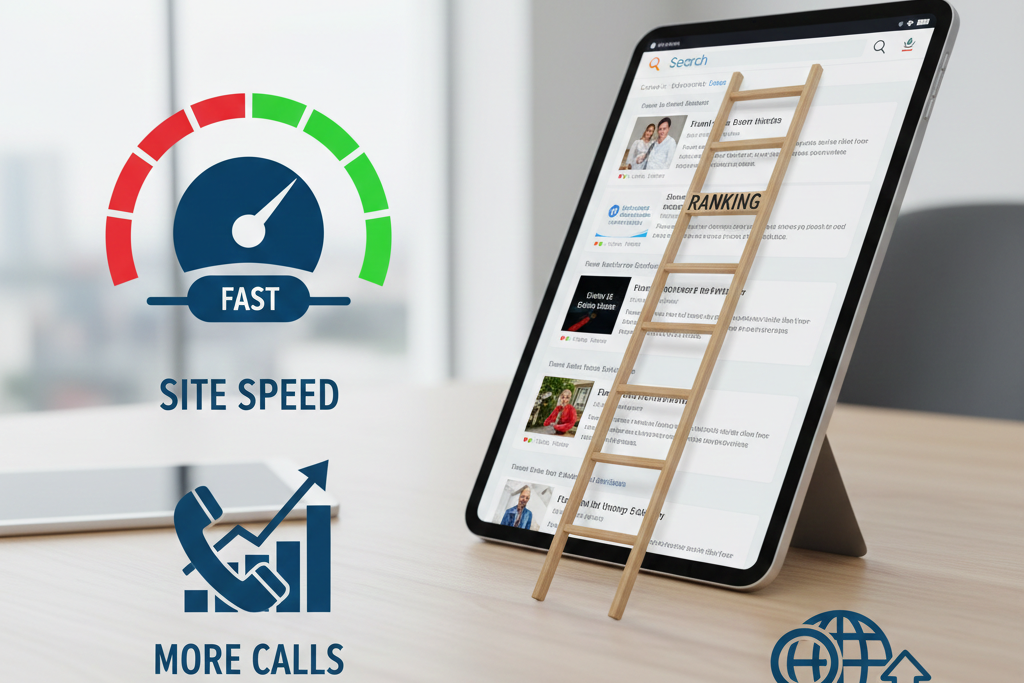
A homeowner’s pipe bursts at 9:47 PM. They search “emergency plumber near me,” tap the first result, and the site hangs. After a few seconds, they hit back and called the next company. That plumber didn’t lose the job because of poor service. They lost because their website was slow.
Site speed isn’t a technical detail. For home service businesses, it’s a marketing and revenue issue. A fast site turns searches into calls. A slow site turns urgency into frustration and lost leads. Homeowners don’t separate the website from the business. To them, the site experience is the company.
Speed affects people first and rankings second. When visitors leave quickly, Google sees that as a weak result. When they stay, scroll, and call, that’s a positive signal. Improving speed helps conversions and SEO at the same time.
What “Site Speed” Really Means for Home Service Websites

Site speed isn’t just how fast a logo appears. It’s how quickly the page becomes usable, especially on mobile. A page can technically load while still feeling slow if text shifts, buttons lag, or the screen freezes.
For home service businesses, a fast site means:
- Pages load quickly on cellular data, not just Wi-Fi
- The phone number and call button appear immediately
- The layout stays stable with no jumping elements
- Taps on services, scheduling, or contact respond instantly
Homeowners are often stressed or in a hurry. A slow site feels like a slow company. Every extra second of waiting increases the chance they leave and call a competitor.
Why Site Speed Directly Impacts Calls
A home services website has one main job: generate calls or quote requests. Speed affects that job in several direct ways.
1) Panic searches disappear fast
Many searches are urgent: leaking pipes, broken AC, lockouts, power issues. These visitors aren’t browsing. They want help now.
They’re looking for:
- Can you help?
- Are you nearby?
- Can you answer quickly?
If the site is slow, they assume the company is slow and move on.
2) Slow pages hide contact info
On slow sites, critical elements often load last:
- Click-to-call buttons
- Phone numbers
- Contact forms
- Scheduling buttons
When people have to hunt, they leave. A fast site puts the next step front and center within seconds.
3) Slow sites reduce trust
A glitchy or outdated site makes a business feel:
- Unprofessional
- Small or unreliable
- Hard to reach
Broken images, overlapping text, or popups blocking the phone number hurt credibility, even if the company does great work.
4) Speed affects repeat business and referrals
Customers often look up a company again months later. If the site is still annoying, they may not call. They’re also less likely to recommend a site that was frustrating to use. A fast site is easier to recommend.
How Google Uses Speed in Local Rankings
Google wants results that satisfy searchers. If users click a listing and quickly return because the site is slow, that reflects poorly on the result.
Speed supports rankings through:
Page experience and engagement
Google tracks signals like:
- Quick returns to search results
- Time on site
- Smooth, stable loading
Fast sites keep users engaged. Slow sites push them away.
Mobile-first indexing
Most local searches happen on phones. Google evaluates sites based on mobile performance. If it’s slow on mobile, it’s slow where it matters.
Core Web Vitals (simple view)
These measure:
- How fast main content appears
- How soon the page is interactive
- Whether elements shift during loading
Good content still struggles if these basics are poor.
Competitive tie-breaker
In crowded markets, many businesses have similar SEO strength. Speed and usability often decide who gets the click and keeps the visitor.
The Real Cost of a Slow Website
A slow site quietly damages the entire marketing system.
- SEO stalls even with good content because visitors don’t stick around
- Ad spend is wasted when paid clicks don’t turn into calls
- Social media traffic dies because those visitors are even less patient
- Offline marketing loses impact when referrals look up the site and hesitate
- Owners feel confused because lost leads are invisible
Speed fixes often feel like a sudden jump in calls because the business stops losing people at the front door.
Common Reasons Home Service Sites Are Slow
Most slow sites share the same issues:
- Oversized images uploaded straight from phones
- Cheap or overloaded hosting
- Too many WordPress plugins doing unnecessary tasks
- Heavy themes and page builders loaded with extra code
- Too many scripts like chat widgets, trackers, and popups
Over time, the site becomes bloated and inefficient.
What a Fast, Local-SEO-Friendly Site Looks Like
High-performing home service sites are simple, clear, and structured.
Local SEO essentials
- Dedicated pages for each main service
- Proper service area pages that are useful, not copy-paste
- Consistent name, address, and phone number
- Clear contact details and map when appropriate
Quality matters more than volume. A few strong pages beat dozens of weak ones.
Conversion essentials
- Sticky click-to-call button on mobile
- Short, simple forms
- Trust signals near calls to action
- Clear service summaries
- Visible hours and emergency availability
The site should guide visitors like a good dispatcher.
Speed essentials
- Compressed images and modern formats
- Minimal scripts
- Fast hosting
- Clean navigation
- No unnecessary visual effects
Simple Speed Wins Without a Tech Degree
Some fixes make a big difference quickly:
- Compress and resize all images
- Replace sliders with one clear hero section
- Remove popups and unnecessary animations
- Clean up plugins and scripts
- Upgrade hosting and enable caching
- Design mobile first, not desktop first
Mobile speed is where most calls are won or lost.
How Speed Fits Into a Full Local Marketing Plan
Speed isn’t the whole strategy. It’s what makes everything else work.
A strong plan includes:
- Optimized Google Business Profile
- Local service pages written in homeowner language
- Reviews and reputation management
- Local citations and backlinks
- Social media for familiarity and trust
All of these efforts funnel traffic to the website. If the site is slow, the value leaks out.
How Home Service Rankers Can Help
Home service owners don’t need more random tactics. They need a system that turns searches into booked jobs.
Home Service Rankers focuses on fixing the foundation first:
- Speed and conversion issues that cause drop-offs
- Local SEO structure built around real searches
- Google Business Profile improvements for map visibility
- Clear, trust-building content
- Simple tracking to show what’s actually working
When the site loads fast, works smoothly on mobile, and makes calling easy, marketing starts doing what it should: generating steady local calls.
Frequently Asked Questions
What’s a “good” load time target for a home service website?
Most home service sites should aim for the main content to appear in about 2–3 seconds or less on mobile, because after that, more homeowners start leaving.
What free tools can be used to check site speed (without hiring someone)?
They can run the site through Google PageSpeed Insights or GTmetrix to get a speed score plus a short list of what’s slowing the page down.
Can a slow website reduce how much of the site Google crawls or indexes?
Yes—if pages respond slowly, Googlebot may crawl fewer pages efficiently, which can delay new or updated pages from being discovered.
Will speeding up a website hurt SEO or cause rankings to drop during changes?
It can if a redesign changes URLs, deletes pages, or removes important content, but a speed-focused cleanup that keeps the same pages and structure is usually low-risk when done carefully.