
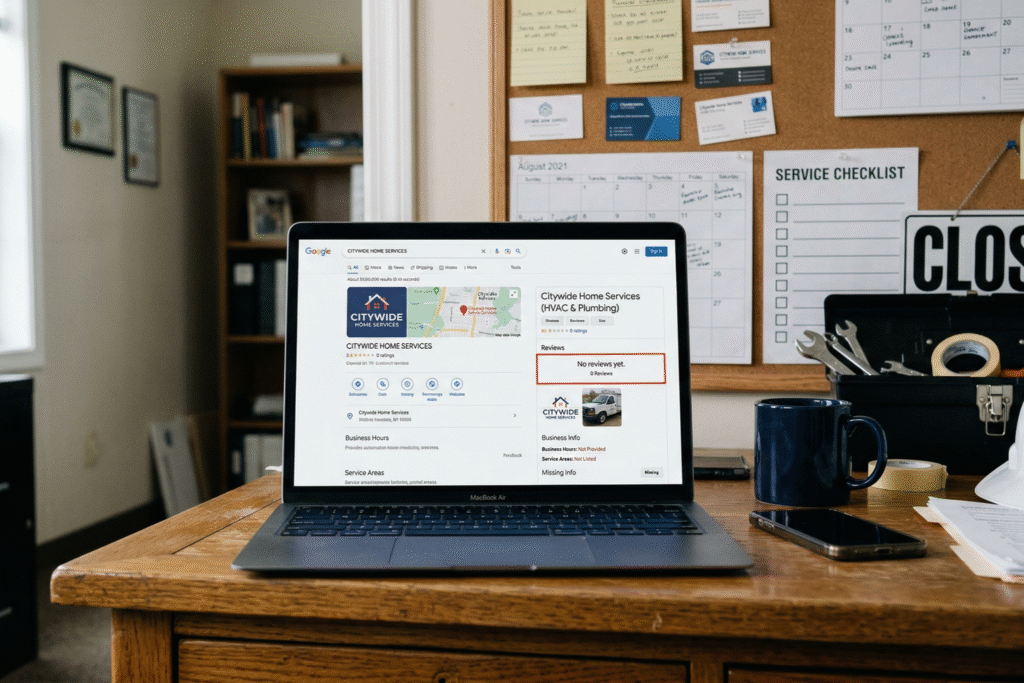
Many home service owners know the frustration. The phone is quiet, the schedule has gaps, and while the business technically shows up on Google, it’s not where customers are looking. Owners try a few things. A Facebook post here. A boosted ad there. Maybe a friend “does SEO.” Nothing really moves the needle.
Meanwhile, competitors keep showing up in the Google map pack, those top three local results. They aren’t always better at their work. They just look clearer and more trustworthy to Google and to customers. As a result, they get more clicks and more calls.
Google Business Profile is often the fastest way for home service businesses to get more calls, especially for “near me” searches. But it only works when Google clearly understands what the business does. One common mistake quietly blocks results for months, even when everything else looks fine.
The #1 Google Business Profile Mistake: Picking the Wrong Primary Category
The biggest Google Business Profile mistake isn’t reviews, photos, or posting. It’s choosing the wrong primary category.
The primary category is one of the strongest signals Google uses to understand what a business actually is. Think of it like a job title. If the job title is wrong, Google puts the business in the wrong place.
When this happens, businesses miss out on searches like:
- “plumber near me”
- “AC repair [city]”
- “emergency electrician”
- “roof repair [town]”
- “water heater repair”
If the primary category is wrong or too broad, Google struggles to match the business to the right searches. That usually means fewer impressions, fewer clicks, and fewer calls.
Why This Happens So Often
Most owners rush through setup. Google makes it feel like a simple form, so they pick something that sounds close and move on.
Common examples:
- A plumber chooses “Contractor”
- An electrician chooses “Home improvement”
- An HVAC company picks “Heating contractor” even though most calls are for AC repair
- A cleaner chooses “Cleaning service” instead of a residential-focused option
- A garage door company picks “Repair service,” which is extremely vague
Sometimes Google suggests categories, and owners assume the first option is best. Sometimes a marketer guesses. Either way, Google doesn’t reward “close enough.” It rewards clarity.
Why the Primary Category Matters So Much

When someone searches “plumber near me,” Google wants to show the best match fast. It looks for businesses that are:
- Relevant
- Nearby
- Trusted
The primary category plays a huge role in relevance.
Behind the scenes, categories help Google:
- Decide which searches the business can appear for
- Decide which features show on the profile
- Decide who the real competitors are
- Understand review context
- Match the listing to search intent
If the category is wrong, Google compares the business to the wrong group.
Example:
A roofing company uses “Construction company.” Google compares it to builders and remodelers instead of roofers. Even with good reviews, it’s no longer a perfect match for roofing searches.
A specific category gives Google confidence. A vague one creates doubt.
What the Right Category Looks LikeHVAC
A strong primary category is:
- Specific
- Accurate
- Focused on the main money-making service
Examples:
- Plumber → Plumber
- HVAC → HVAC contractor or Air conditioning repair service
- Electrician → Electrician
- Roofing → Roofing contractor
- House cleaning → House cleaning service
- Junk removal → Junk removal service
A useful rule: the category should match what customers type when they’re stressed and need help. People don’t search “home improvement” when water is leaking. They search for “plumber.”
Businesses With Multiple Services
Most home service companies offer several services. That’s fine. Google still wants one main identity.
Plumbing, drain cleaning, and water heaters still fit under “Plumber.”
HVAC, duct cleaning, and thermostats still fit under “HVAC contractor.”
The primary category stays focused. Secondary categories support the extras.
Signs the Category Is Holding the Business Back
- The business only shows up when people search its name
- It ranks for odd or irrelevant searches
- It gets views but very few calls
- Competitors dominate core service searches
- Google keeps suggesting category or name changes
The profile looks complete, but it isn’t aligned.
How to Fix the Primary Category
Step 1: Choose the main service you want to be known for
Pick the service with the most demand, profit, or growth potential.
Step 2: Check top competitors
Search your main keyword and look at what categories top map results use. Don’t copy blindly, but look for patterns.
Step 3: Set the best primary category and limit secondary categories
Add only categories that match real services. Avoid stuffing.
Step 4: Reinforce the category everywhere
Update services, description, photos, posts, and website content so everything supports the same message.
Step 5: Track results and adjust slowly
Watch calls, clicks, and search terms in GBP Insights. Expect gradual improvement, not instant results.
Website Mismatch Can Undermine the Fix
A common issue: the profile says “Plumber,” but the website says “quality home services” or “we do it all.”
That’s vague. Google needs clarity.
A strong homepage should clearly show:
- The main service
- The service area
- Key services
- Trust signals
If the website doesn’t back up the category, Google loses confidence.
Other Issues That Make Category Problems Worse
- Inconsistent name, address, or phone number across the web
- Weak or vague services lists
- No review system or poor review responses
- Lack of real photos
- Ignored Q&A section
Fixing the category works best when these issues are cleaned up too.
A Simple Local SEO Checklist
Google Business Profile
- Correct primary and secondary categories
- Accurate service areas and hours
- Detailed services list
- Clear description
- Real photos updated regularly
- Regular posts
Website
- Clear service + city on homepage
- Dedicated service pages
- Matching contact info
- Fast, mobile-friendly site
Trust Signals
- Consistent reviews
- Review responses
- Basic directory consistency
- Proof of legitimacy
How Home Service Rankers Can Help
Home Service Rankers helps home service businesses stop guessing and start ranking in Google Maps.
They focus on what drives calls, not vanity metrics.
They help with:
- Finding real ranking blockers
- Choosing the right categories
- Optimizing profiles for calls
- Aligning websites with Google’s expectations
- Creating a clear, understandable plan
For many businesses, the fastest win is fixing the primary category. From there, everything else becomes easier to build.
Frequently Asked Questions
How long does it take for a primary category change to affect rankings?
Most businesses see changes within about 1–2 weeks, but some edits can take longer to fully settle depending on Google’s review and indexing.
Can changing the primary category get a Google Business Profile suspended?
It can trigger extra checks (like re-verification) if Google thinks something doesn’t match guidelines, so the listing details should be accurate and consistent before making big changes.
Should a home-based or mobile service business hide its address on Google Business Profile?
Yes, if it’s a true service-area business, Google recommends hiding the address so the profile shows service areas instead of a home location.
What’s the safest way to change important info (like address or phone) without delays or issues?
Make only necessary edits, keep the website and major directories consistent first, and expect that some edits may take longer than a few minutes to review.